Anzac Day
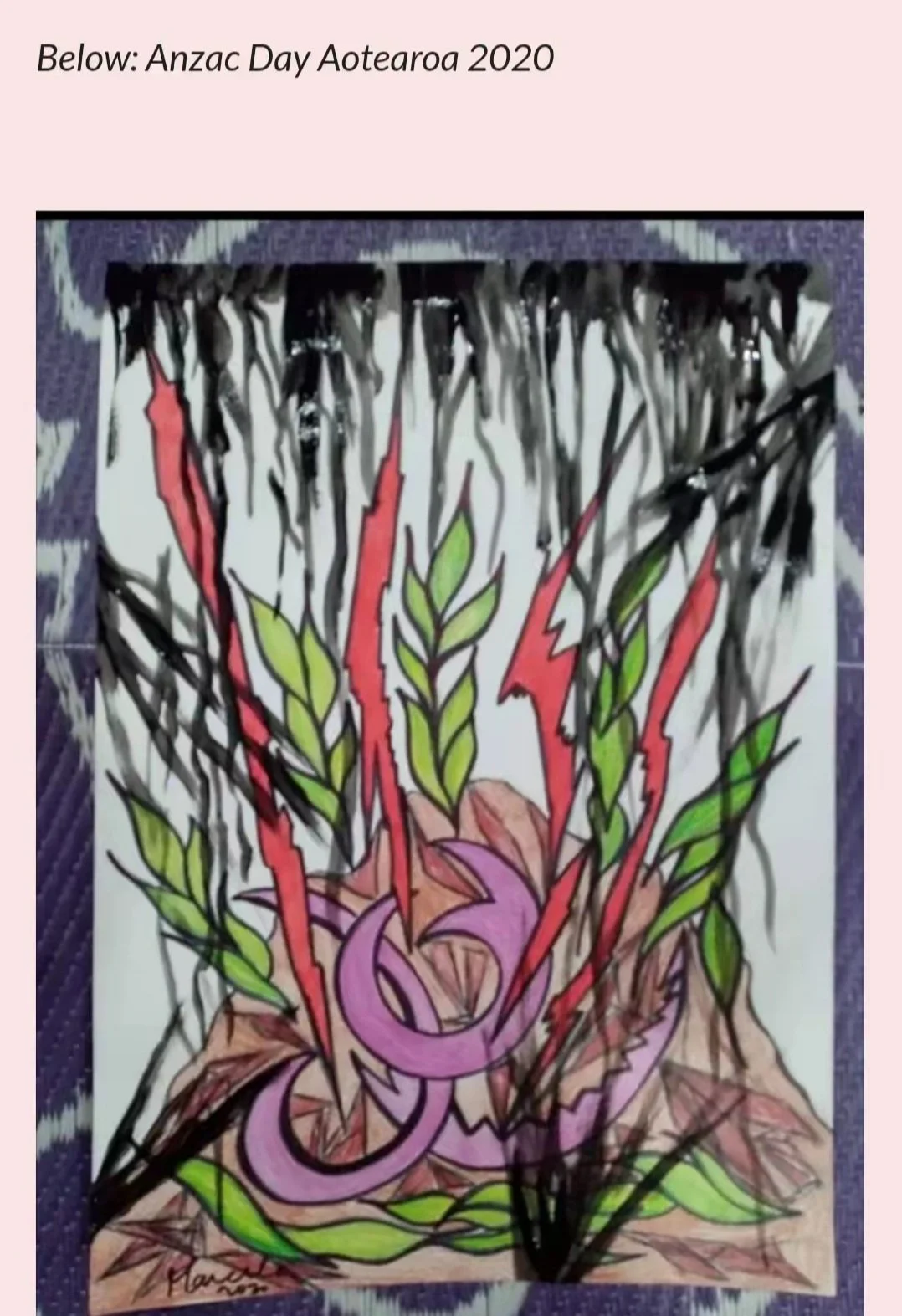
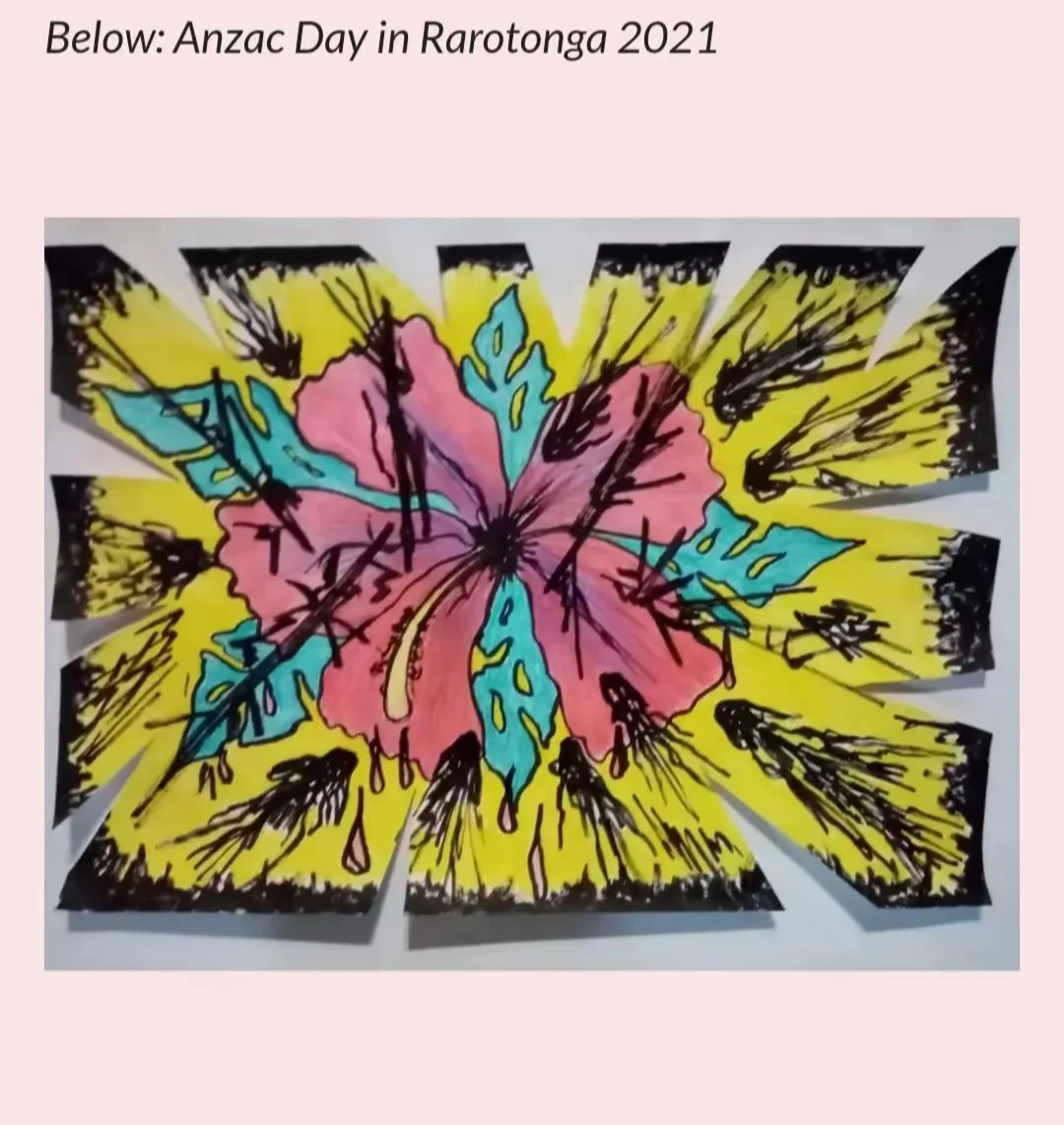
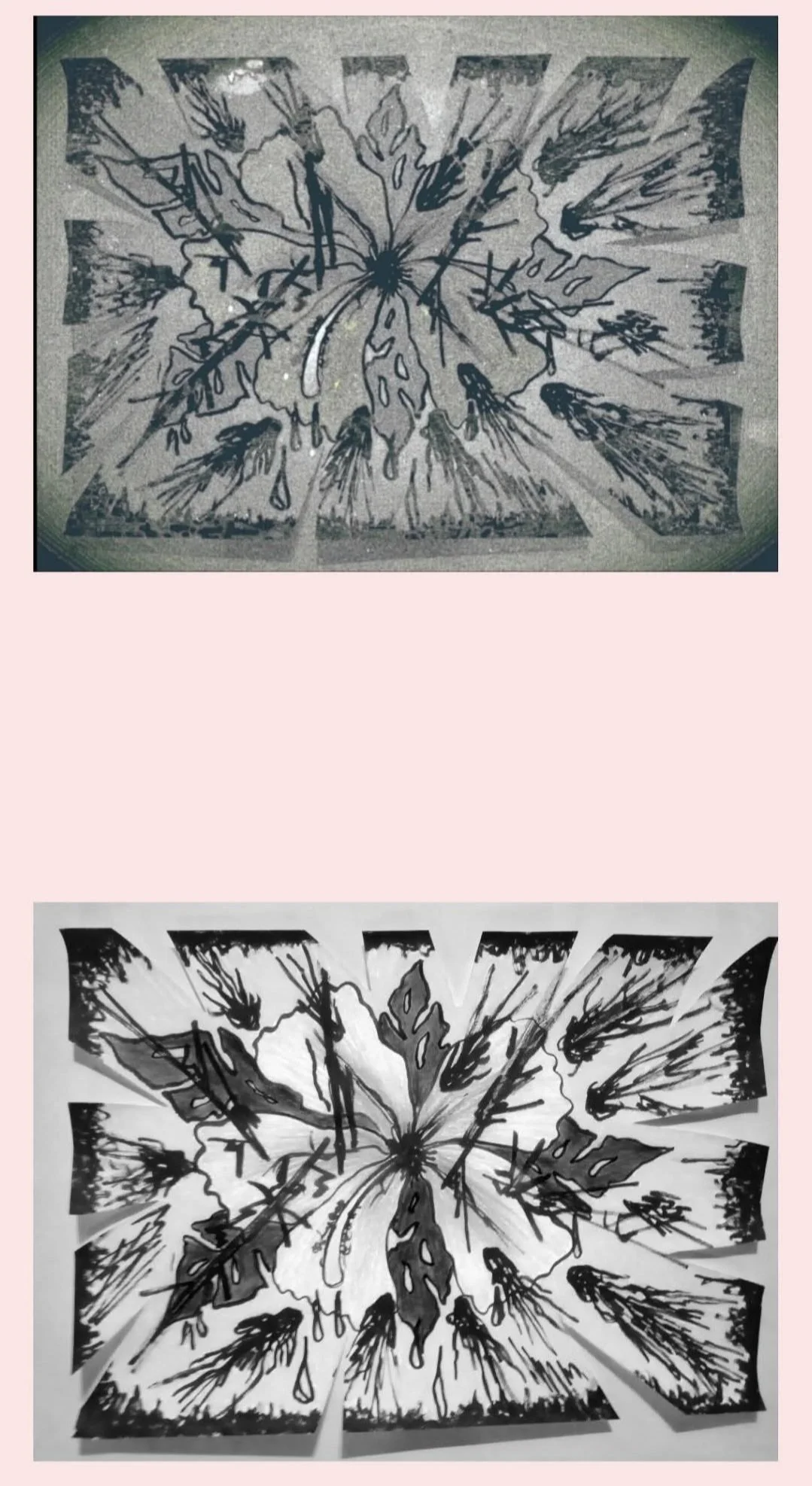
I contemplated many times, about whether or not to write about Anzac day. Sometimes words don’t say enough. I’ve drawn art when writing did no justice. Anzac Day for many, is a chance for people to gather collectively and pay respects, to bloodlines, to memories, feelings of loss and grief, etched in people’s souls, turned into pride, of men and women who died in a war, or who returned home safely to those they loved.
What initially started out as a memorial for those who died at Gallipoli, Anzac Day is now a day of remembrance for people who have died and served in all wars. In our Cook Island family, our grandfather’s father’s uncles, Papa Martin Mitchell and Papa John Mitchell were in the 3rd Rarotongan contingent that joined the New Zealand Expeditionary Force (NZEF), sent to Sinai and Palestine between 1915 and 1918. Papa Anthony Manuel (grandpa's Uncle) was in the New Zealand Māori (Pioneer) Battalion, 1st Rarotongan Contingent in 1916.
More recently the Mayor of Arras in France recognised three Cook Island men, Angene Angene (Rarotonga), Solomon Itaaka (Aitutaki) and Tau Kopungaiti (Mangaia) who were part of the 43 Māori Pioneer Battalion. They were involved in preparing tunnels, leading up to the Battle of Arras, where 20,000 Allies were stationed. These men had carved their names and the lord’s prayer into the walls of the tunnels and a pūtātara (conch shell) was also found in the same place. (1). The pūtātara, in our culture is an instrument that is used for communicating long distances. It was used for callings across oceans and is often used today in ceremonies. One can only imagine why these men took the pūtātara so far away, to be with them during this time.
Our papa’a grandfather was a truck driver in the Korean war. His truck went over a landmine and ended up down the side of a cliff, leaving him with a severe injury and he returned home. I have been told our grandmother’s father, had Uncles who served in WWI also. We have in our bloodlines, men who left their homes, for the British empire, that had made its way across the world.
Winston Churchill, Prime Minister of England, for two terms, 1940–45 and 1951–55, has been praised throughout history for ‘saving the world from the Nazis.’ However very few recognize, he fought in imperialist invasions himself and he is less well known for some of his racist commentary when taking part in these encounters. (2) Churchill was involved in the creation of Israel, as early as 1917, during WWI. At the time he served as a Colonial Officer to the Prime Minister, dealing with colonial matters abroad. In 1921 he organised and attended the Cairo Conference, where essentially, military leaders came together to divide up the Middle East after the fall of the Ottoman Empire in WWI, of which Britain and its allies fought for. (3)
After the volunteer numbers for the NZEF to go to WWI were low, Aotearoa, reinstated conscription for compulsory military service, in 1916. (4) There were many iwi that strongly opposed the war, and the government decided to call on young men from the Cook Islands and Niue to take their place. (5) It was re-introduced, as the first conscription began in 1845, when the government introduced the Militia Ordinance for men aged 18 to 60, to fight in the New Zealand Land Wars. (6) Indigenous land wars of colonial powers barely get a whisper on remembrance days, as this would mean an acknowledgement of colonial invasion on indigenous lands. Nor does the lack of access on return for state stipends and funds, that were accessible to non-indigenous men and women but not indigenous men and women who served. Also missing from remembrance days, is an acknowledgement of conscientious objectors.
The conscientious objectors were those who refused to fight for the political class. One of the most well known in the USA is Muhammad Ali who refused to fight in Vietnam. Others include Tūhoe prophet Rua Kēnana, who was arrested by a large number of police constables for his principles opposing conscription (7). In 1915 Archibald Baxter, and 13 other conscientious objectors, were put in the line of fire, each on a pole, in what was known as “the crucifixion” hands and feet tied behind their backs for up to four hours.(8).
The USA ended military conscription in 1973, Aotearoa in 1972. However, after Israel bombed an Iranian embassy in Syria, killing 16 people in April of 2024, the USA as an ally of Israel, reopened the draft 53 years later, for its military, last year in December and labeled it automated registration. (9) Men between 18-25 are required to register for military duty, and if they do not, face a fine $250,000US, a possible five-year jail term and loss of state funded aid. Young men in the USA have been told to give up their lives, leave their families, step foot on Iranian soil, and fight.
And thus the cycle repeats itself. Only in 2026, war is big business. During 2025, 100 of the world's leading arm-producing companies collectively made $632 billion in profits. (10). War makes money and everyone profiteering off it knows this. In 1993 Tupac Shakur, son of the Black Panther Afeni Shakur, wrote the song, “Keep your head up,” and said, “You know it's funny, when it rains it pours they got money for wars, but can't feed the poor.” New Zealand is set to inject $12 billion, over the next four years into the military. (11). Surely there are better things to invest $12billion dollars in like housing, education and health. As a result, memorial days, are often opportunistic moments for arms dealers, their financiers, and politicians who support them, to stoke the flames of war for the military industrial complex. Those that die whether they are civilians or soldiers, as a result of war, memories of them are respected by some and used as a political ploy by others.
Ultimately, the people of the homeland, of the countries we invade, pay the ultimate price for imperialist intrusion. We hardly hear their voices, their testimonies of what they have seen, witnessed and experienced firsthand. Parents losing children and children losing parents. People losing limbs, the trauma of sound, explosions, drones, snipers, soldiers entering villages and camps, the trauma of screams, every single day, hour and minute. Families are killed in large numbers. It is said that in Palestine, families live in buildings on different levels, Uncles, Aunties, cousins, grandparents and so when one building is blown up, this is how generations are lost. I cannot remember a time, when Palestine or Iran last invaded Atiu, Mangaia, Rarotonga or Mitiaro, or any of the countries I have lived in and travelled to. When it comes to war, the korero is often “war is over there,” in some far-off distant land, as if that homeland does not have people who die, whilst at the same time, we afford ourselves the time, to pay reverence to our loved ones who have traveled abroad to these lands and who have lost their lives.
It is as if we are allowed to experience loss and grief and no one else is. We are allowed to arm ourselves and fight for an empire, but the lands we go to, are not allowed to defend themselves with armed resistance. We are allowed to pay respects and honour to the ones we loved and lost, but we demonise rather than see honor in the people who are defending their homeland, as if we would not do the same. On this Anzac Day I hope, when we grieve those, we have lost, we take a moment, to understand why wars exist, who is benefiting and we grieve with those, who have experienced the brutalisation of violent, colonial imperialist wars.
Reference:
Gone but not forgotten: France acknowledges Cook Islands WWI soldiers - Cook Islands News
The dark side of Winston Churchill | The Independent | The Independent
Churchill, Palestine and Israel, Part 1: 1917-1945 - Richard M. Langworth
https://peaceactionwellington.wordpress.com/2026/04/19/what-does-ethical-
The business of war: US-led global arms industry thrives as revenues hit record highs
The multibillion-dollar boost for New Zealand's military: What you need to know | RNZ News
